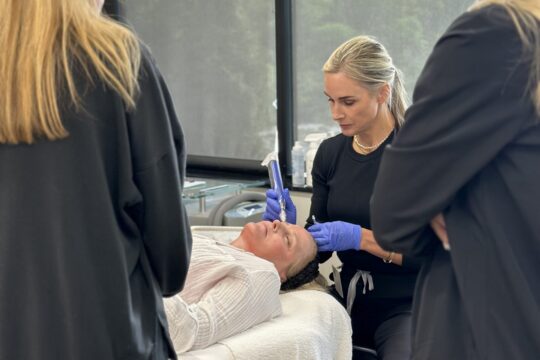

The hardest part of medical aesthetics training often starts after the class ends: turning new information into something a provider can consistently use in a real practice.
You leave training with pages of notes, new ideas, and a list of changes you want to make. Then you return to a full schedule. Within a few days, the workbook is sitting unopened, patients are booked back-to-back, and the old workflow starts taking over again.
After medical aesthetics training, five common problems can get in the way of implementation: leaving without a clear plan, waiting too long to practice, letting follow-up questions go unanswered, falling back into old workflows, and trying to change too much at once.
A better approach is to choose a small number of changes, assign ownership, practice while the information is fresh, ask for clarification when questions surface, and build the new process into the way the practice already operates.
At MINT Aesthetics, we think about training through that implementation lens. Our education is built alongside the day-to-day realities of an operating medspa, where a new idea has to work within patient schedules, team responsibilities, clinical standards, and existing systems. The question after training is less about how much information was covered and more about what will actually change once the provider gets home.
Here are five post-training mistakes that can keep useful education from becoming part of everyday practice, along with a better approach for each one.
1. Leaving Medical Aesthetics Training Without an Implementation Plan
One of the easiest mistakes is treating attendance as the finish line.
A provider may leave training with a long list of ideas but no decision about what will actually change on Monday morning. Realistically, every idea cannot receive the same level of attention at the same time.
Without a specific implementation plan, the new information has to compete with existing responsibilities, habits, patient schedules, and workflows. The familiar process is usually easier to fall back on.
What to do instead: choose your first changes before you leave
Before leaving a training, identify the first one to three actions that should happen next.
That might mean practicing a new consultation framework, updating a treatment setup checklist, reviewing patient-selection considerations with the clinical team, scheduling supervised hands-on practice, improving how before-and-after photos are captured, or revising part of the patient follow-up process.
The goal is not to implement the entire training immediately. One useful change that is completed and repeated has more value than a long list that stays in a notebook.
Before leaving, answer four questions:
- What are we changing?
- Who owns the next step?
- When will it happen?
- How will we know it has been completed correctly?
If those answers are unclear, the training is still an idea rather than an implementation plan.
2. Waiting Too Long to Practice What You Learned
The period immediately after aesthetic provider training gives providers an important opportunity to reinforce what was covered.
The instructor’s explanations are still fresh. Small details are easier to recall. Practice also tends to reveal which parts of the material are clear and which parts need more explanation.
Wait too long, and those details can become harder to reconstruct. Notes that made perfect sense in the training room may need more context several weeks later. A provider may remember the general concept while losing part of the sequence, positioning, language, or decision-making behind it.
What to do instead: schedule practice before your normal routine takes over
Don’t return from training and assume practice time will appear on its own. Put it on the calendar.
Depending on the subject, post-training practice might include reviewing notes the next business day, rehearsing a consultation framework, reviewing device setup or treatment flow according to approved protocols and manufacturer guidance, working through case scenarios, or writing down questions that become apparent during practice.
Clinical education requires another layer of judgment. Practice should remain within the provider’s scope of practice, applicable protocols, manufacturer guidance, and required level of supervision. Completing a course does not automatically mean a provider is prepared to perform every technique independently.
The goal is to use the information while the context is still fresh instead of trying to reconstruct it weeks later.
3. Not Asking Follow-Up Questions After Training
Some of the most useful questions do not appear until a provider tries to apply the training.
A process may seem straightforward during class. Back at the practice, new variables appear. The clinic’s workflow may be different. A patient scenario may not fit neatly into the examples discussed. Or a provider may realize that one small detail felt clear in the room but is harder to explain or apply afterward.
Providers sometimes hesitate to ask because they think they should already know the answer. Others decide the question is too minor to justify reaching back out.
That can lead to guessing, inconsistent execution, or quietly abandoning the new process.
What to do instead: keep a running list of implementation questions
Start a question list as soon as implementation begins.
Instead of filling in gaps from memory, use the appropriate training or support channel to clarify them. Specific questions are easier to address than broad ones. Include what you were trying to do, where the uncertainty appeared, and what you want to confirm.
There also does not need to be an arbitrary deadline for having questions. In many cases, a better question appears after a provider has practiced, encountered a problem, and identified exactly where more guidance is needed.
Follow-up is part of putting education into practice.
4. Falling Back Into the Old Workflow
Every provider and practice has default ways of working.
It might be a familiar consultation script, a preferred treatment pattern, an old documentation habit, a room setup, or a workflow the team has followed for years. Even when a new approach makes sense, the familiar process is easier to reach for when the schedule becomes busy.
Knowing the new process is not the same as having repeated it enough for it to become routine.
That is when the old way starts creeping back in.
What to do instead: build the new process into the workflow
Memory is a weak implementation system.
If training changes the way something should be done, update the tools surrounding the behavior. Revise the checklist or template. Put the reference material where it will actually be used. Give the provider appropriate extra time during the first attempts. Review the new process before the relevant appointment instead of trying to recall it in the moment.
If the change affects several team members, make sure the team knows what changed, who is responsible for each part, and where the current process is documented.
The easier the new process is to repeat, the less it depends on someone remembering a page from a workbook during a busy clinic day.
5. Trying to Implement Everything From Training at Once
Good training can generate a lot of ideas.
A provider or manager may return wanting to change treatments, consultations, patient education, pricing, team communication, follow-up, marketing, documentation, and several other processes at the same time.
Trying to launch every change at once usually creates another problem: none of them receive enough attention to become consistent.
The provider feels behind. The team receives several new instructions at once. And education that felt useful during training starts to look like a growing list of unfinished projects.
What to do instead: sequence the changes
Choose the change with the clearest value and a realistic path to implementation, then start there.
This does not mean the other ideas are unimportant. It gives each one a better chance of actually becoming part of the practice.
A simple post-training sequence might look like this:
First: Review the material and choose the highest-priority change.
Next: Practice the new skill or process and collect questions.
Then: Begin applying it in the appropriate setting, with the required oversight and protocols.
After that: Review what is working, identify what still needs clarification, and decide whether the process is ready to become standard.
Only then should the next major change move to the front of the list.
The timeline will vary based on the type of training, the skill being developed, the provider’s experience, and any supervision or competency requirements. What matters is having a sequence instead of treating every note from the training as equally urgent.
Make Your Medical Aesthetics Training Count After You Get Home
The value of training is not measured by how many pages of notes a provider takes or how motivated the team feels when the course ends.
It shows up in what happens afterward.
Choose something specific to implement. Decide who owns it. Practice while the details are fresh. Keep track of questions. Put systems around the new process so it can survive a busy schedule.
Then review what happened before moving to the next change.
The goal is not to remember every sentence from a training. It is to make the most useful parts of that education visible in the way the provider and practice actually operate.
Need Help Putting Your Training Into Practice?
Some questions only become clear after training, when a provider is back in the practice trying to use what was taught.
MINT Virtual Training gives providers and practices a way to get customized follow-up support without another trip to Kansas City. A virtual session can be used to address specific clinical or business questions, review areas that are getting stuck, and continue the learning process after an in-person training.
Learn more about MINT Virtual Training
Clinical training and implementation should remain within the provider’s scope of practice and follow applicable laws, protocols, manufacturer guidance, and supervision requirements.