Hiring an experienced provider feels like a safe bet, and to be sure, it comes with benefits. They’re already equipped with credentials, clinical hours, and maybe even a following of their own. You skip the ramp-up period, avoid the early mistakes and get someone who can (theoretically) hit the ground running.
However, the “ready-made” provider also comes with some built-in challenges that aesthetic practices tend to overlook. They weren’t trained on your protocols and standards, but somebody else’s. They may require some unlearning, which is historically tougher than regular old learning.
In fact, the most consistent, high-performing teams tend to reach and maintain that level by growing their talent from within. This investment strategy is fundamentally different from hiring well-established talent, as are its many benefits.
You Control What They Learn
When you manage your training program internally, you get to decide exactly what knowledge your team absorbs and in what order. That level of control is something you simply cannot buy when you hire someone who trained elsewhere.
When training and developing from within, you are afforded the unique opportunity to closely align every provider to your consultation framework, your treatment protocols, your patient communication standards and your philosophies from day one. There’s no period of “unlearning” required, and no flux period while you wait for the new hire to adjust to your clinic. The learning is intentional and specific to your operation.
This is one of the key advantages of programs like MINT’s Online E-courses full name linked – Online E-courses) , which are built specifically for medical aesthetic practices. Rather than generic clinical content that covers the industry broadly, the curriculum targets the exact knowledge gaps that affect your day-to-day performance, whether that’s patient consultation skills, front desk efficiency or laser safety compliance. You’re not sending your team through a generic certification, but intentionally building a specific type of provider.
Training Together Improves the Team Dynamic
One of the often-overlooked benefits of in-house development is what happens among team members when they learn side by side. Sharing the training experience allows team members to share the same framework, terminology and practices. When your injector, your laser tech and your front desk coordinator go through the same consultation module together, they leave with a clear, cohesive understanding of each provider’s role and where they fit in the overall patient journey.
This rapport-building exercise translates directly into everyday interactions in your practice. Providers who trained together have a shorthand that makes handoffs more fluid, communication more efficient and patient experiences more complete. When something breaks down, they already know how to talk to each other about it because of their shared language and understanding.
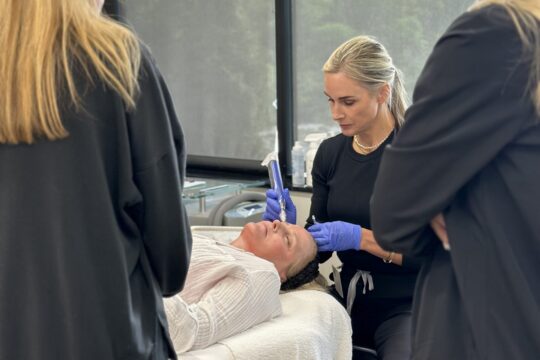
MINT’s In-Person Training options (https://mintaesthetics.com/hands-on-training/) are designed with this in mind. Bringing your team through a session together doesn’t just improve individual skill sets; it builds a culture of shared accountability that you can’t create by hiring people with different institutional backgrounds and hoping they eventually form their own team dynamics.
The Retention Math No One Talks About
Staff turnover in the aesthetics industry is expensive in ways that are easy to ignore or misjudge if you aren’t paying close attention. The commonly cited figure for replacing an employee runs between 50% and 200% of that person’s annual salary when you account for recruiting costs, onboarding time, lost productivity and the temporary dip in patient experience during the transition. For a mid-level provider earning $75,000 per year, you’re potentially looking at a six-figure cost to replace them.
Investing $50,000 in comprehensive training programs for your existing team starts to look very different when measured against that math.
But the numbers by themselves don’t really capture the qualitative side of things; employees who receive meaningful, ongoing professional development report higher job satisfaction and are significantly less likely to leave. A Gallup study on employee engagement found that feeling supported in growth is one of the top predictors of retention, often outranking compensation as a predictor of long-term satisfaction. When you invest in someone’s education, they notice, and they tend to stay.
This is especially true in medical aesthetics, where clinical confidence is directly tied to job satisfaction. A provider who feels uncertain in their technique, unsure how to handle an adverse reaction or undertrained on a new device is not just a liability; they’re also a flight risk.
Grown Talent Reflects Your Standards
There’s a subtler argument here that, like the retention factor, tends to go overlooked: when you train someone from the ground up, they learn what excellence looks like through your lens. A provider who trained at a high-volume discount medspa may have excellent technique. Still, their baseline for patient experience, their view of thoroughness and their comfort with saying “I’m not sure, let me look into that” might look very different from yours. None of that is a character flaw. It’s just the reality of where they came from.
Providers developed in-house, especially when that development is consistent and structured, tend to internalize your standards organically. They don’t have to unlearn anything because they never learned it any other way. Over time, those providers become your best recruiters while acting as ambassadors who carry your clearly defined culture into the next generation of hires.
The Compounding Effect of Continuous Learning
One of the biggest mistakes practices make is treating training as a single point in the evolution of a staff member. A new hire goes through onboarding, completes a few modules and then the formal education stops. From that point on, learning happens reactively, only when something goes wrong or a new device arrives.
The practices that outperform their peers tend to treat training as an ongoing operating expense, not a one-time capital investment. That means scheduling regular refresher courses, covering new treatment modalities as they emerge, reinforcing business development skills like consultation and patient communication, and giving your team structured ways to grow into more senior roles.
MINT’s E-course subscription makes this kind of continuous learning accessible. Rather than a single course event, it gives your team an entire library of resources they can move through at their own pace, from clinical skills to business operations to compliance knowledge. The goal is to make growth a habit, not an occasion.
Putting It All Into Practice
Committing to internal development doesn’t have to mean building a training department from scratch or trying to cram a weekly seminar into your schedule. Most practice owners who do this well start with a few concrete steps:
- Identify the specific gaps in your team’s knowledge or performance right now, whether clinical, operational or patient-facing.
- Choose structured resources, like MINT’s courses and hands-on sessions, that address those gaps with content relevant to your practice type.
- Build training time into your schedule, even if it’s just two hours a month, and protect it the same way you protect revenue-generating appointments.
- Measure what changes. Track conversion rates, patient satisfaction, rebooking percentage and staff confidence levels before and after training initiatives.
Stay consistent, and like any other investment, your returns will compound consistently. Your team gets stronger, your protocols get tighter, your patient outcomes get more predictable and your reputation as an employer who invests in people starts to attract the exact kind of candidates you actually want to hire.
Ready to Build a Team That Grows With You?
The decision to prioritize in-house development over recruitment isn’t transactional in the way you might think; it’s not trading experience for something else. It’s about building the experience you’re looking for in a more effective way. The providers on your team who received structured, ongoing education within your practice are more effective than generally competent providers trained from the outside.If you want to see what that looks like in action, explore MINT’s full training catalog, including online e-courses, virtual training and hands-on sessions designed for practices at every stage of growth.